> ## Documentation Index
> Fetch the complete documentation index at: https://docs.unifygtm.com/llms.txt
> Use this file to discover all available pages before exploring further.
# Send records from Clay sheet
> Learn how to send records from a Clay sheet into Unify via webhook.
## Overview
This tutorial walks through the process of sending records from a Clay sheet
into Unify. To do this, we'll set up a webhook in Clay that sends records to the
[Data API](/developers/api/data/overview).
This guide uses a sheet of companies as an example, but the same approach can
be used for any object type, such as `person` or a custom object.
## Prerequisites
* An existing Clay sheet that you want to send into Unify
* An existing [API key](https://app.unifygtm.com/dashboard/settings/integrations/api-keys) for Unify
## Steps
Navigate to your Clay sheet and open the **Actions** pane.
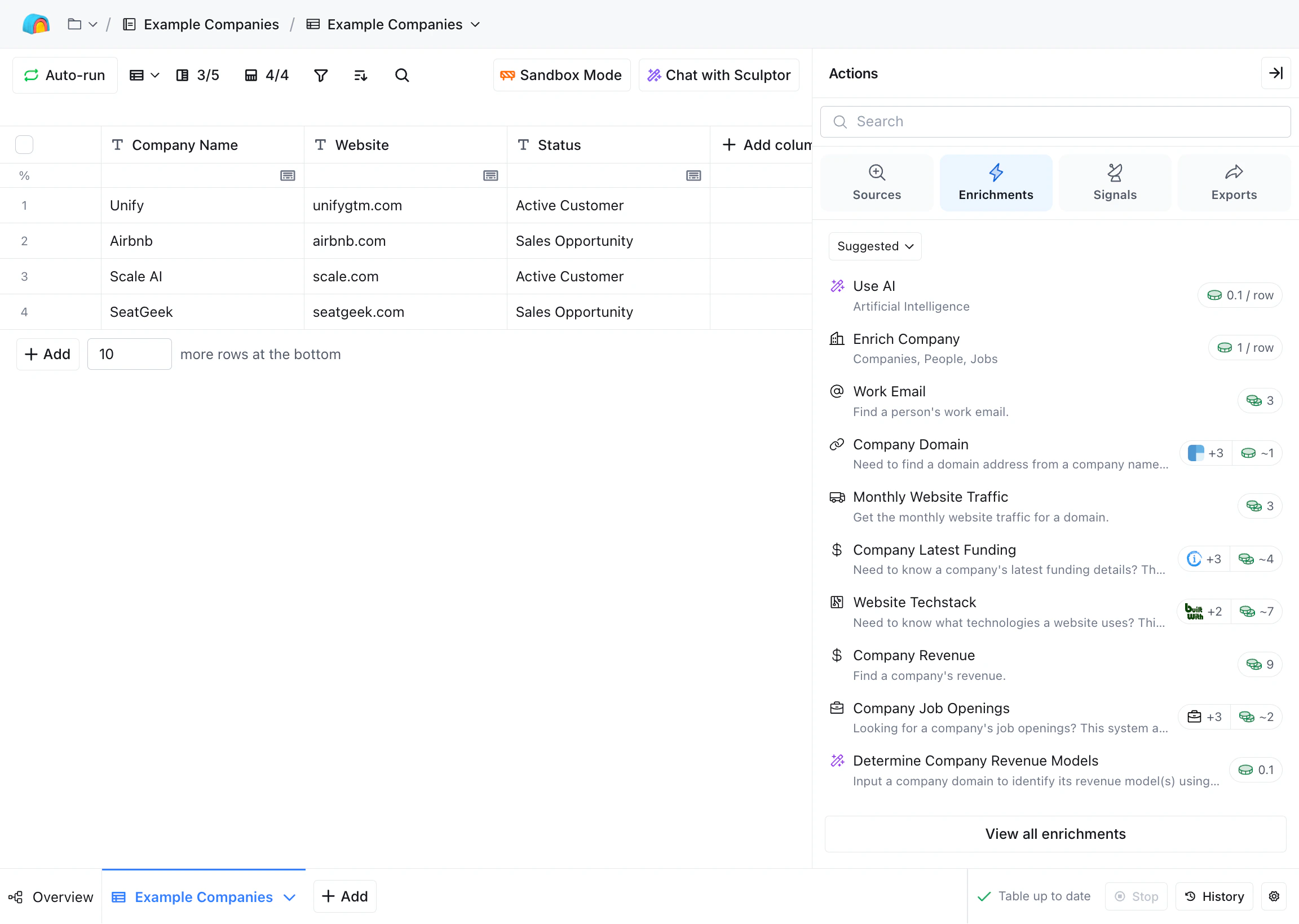 Under **Enrichments**, select **View all enrichments** and then choose **HTTP API**.
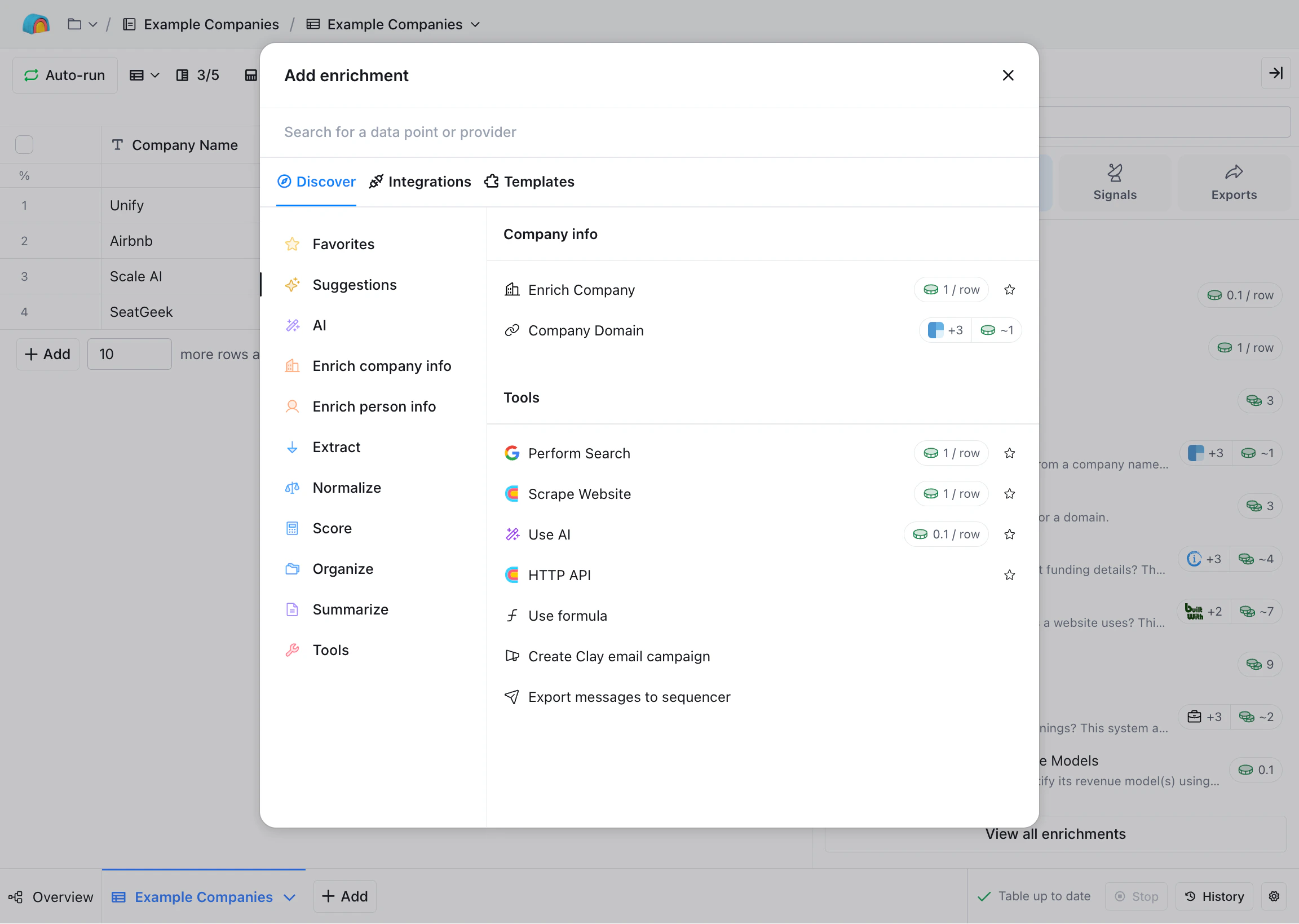
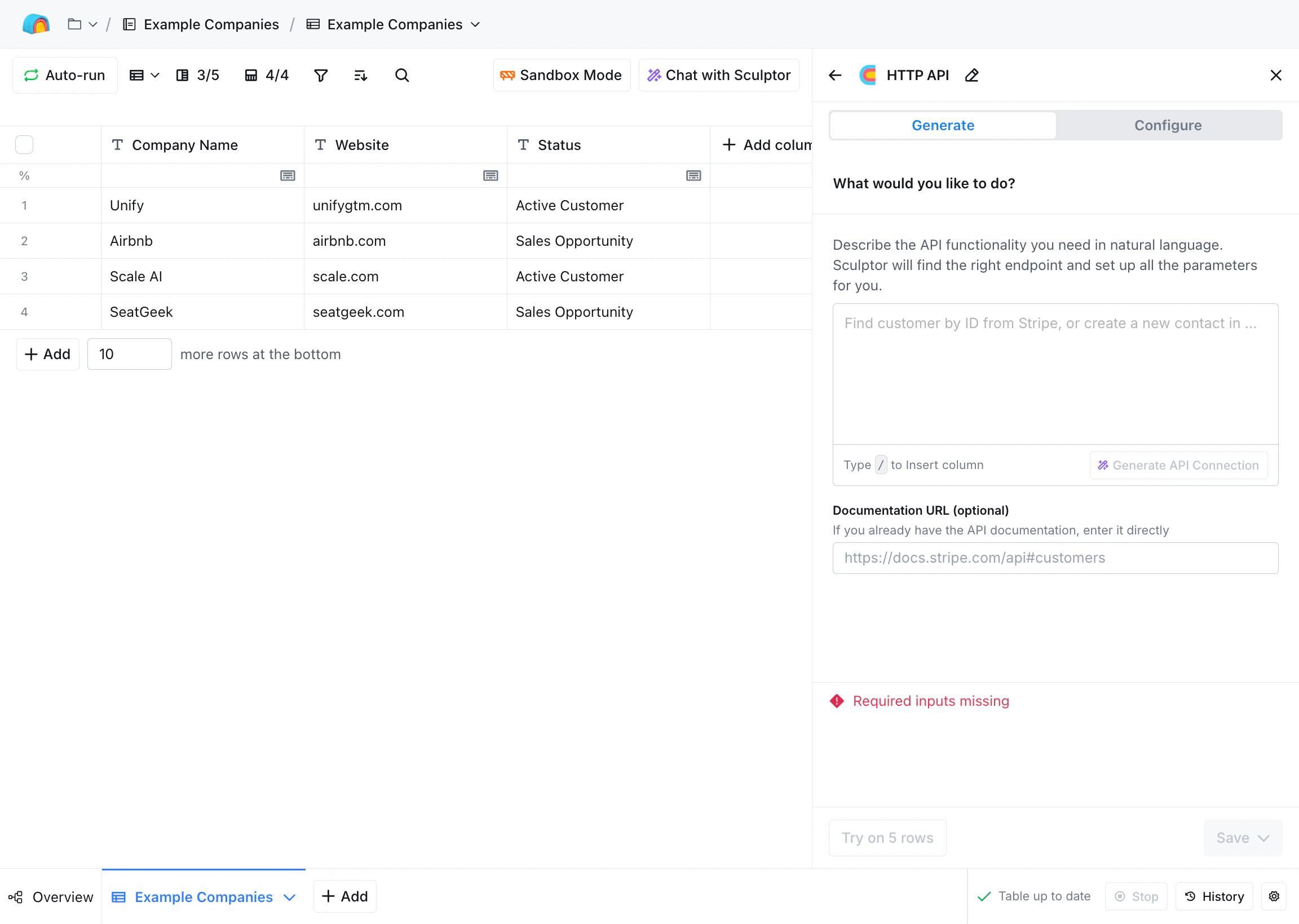 Select the **Configure** tab. Under **Select HTTP API (Headers) account**, choose **Add account**.
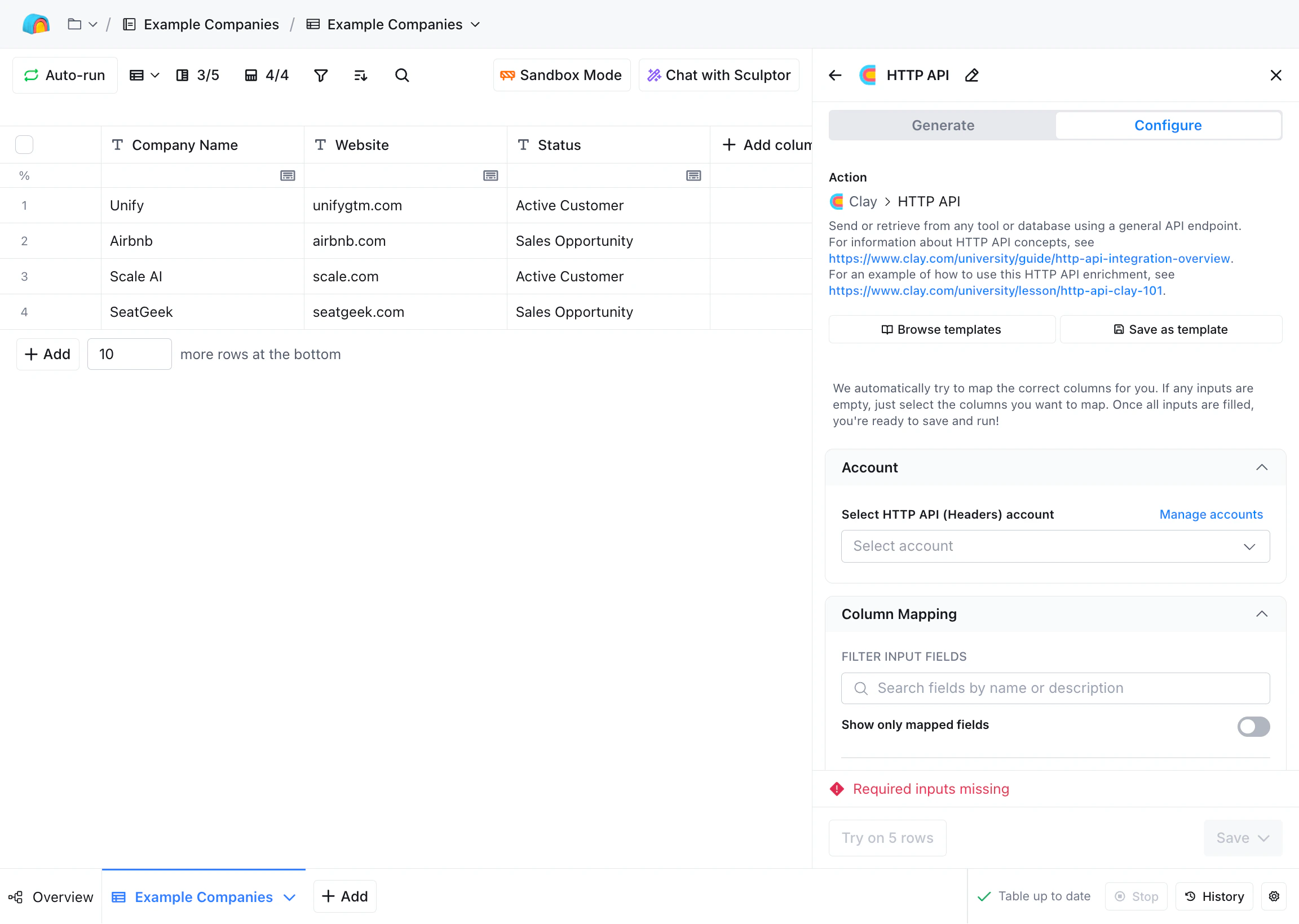 If you have already completed this step in the past, you can simply select
your existing headers account for Unify.
Give the new account a name (e.g., "unify-api") and add a header named
`X-Api-Key` whose value is your Unify API key.
If you have already completed this step in the past, you can simply select
your existing headers account for Unify.
Give the new account a name (e.g., "unify-api") and add a header named
`X-Api-Key` whose value is your Unify API key.
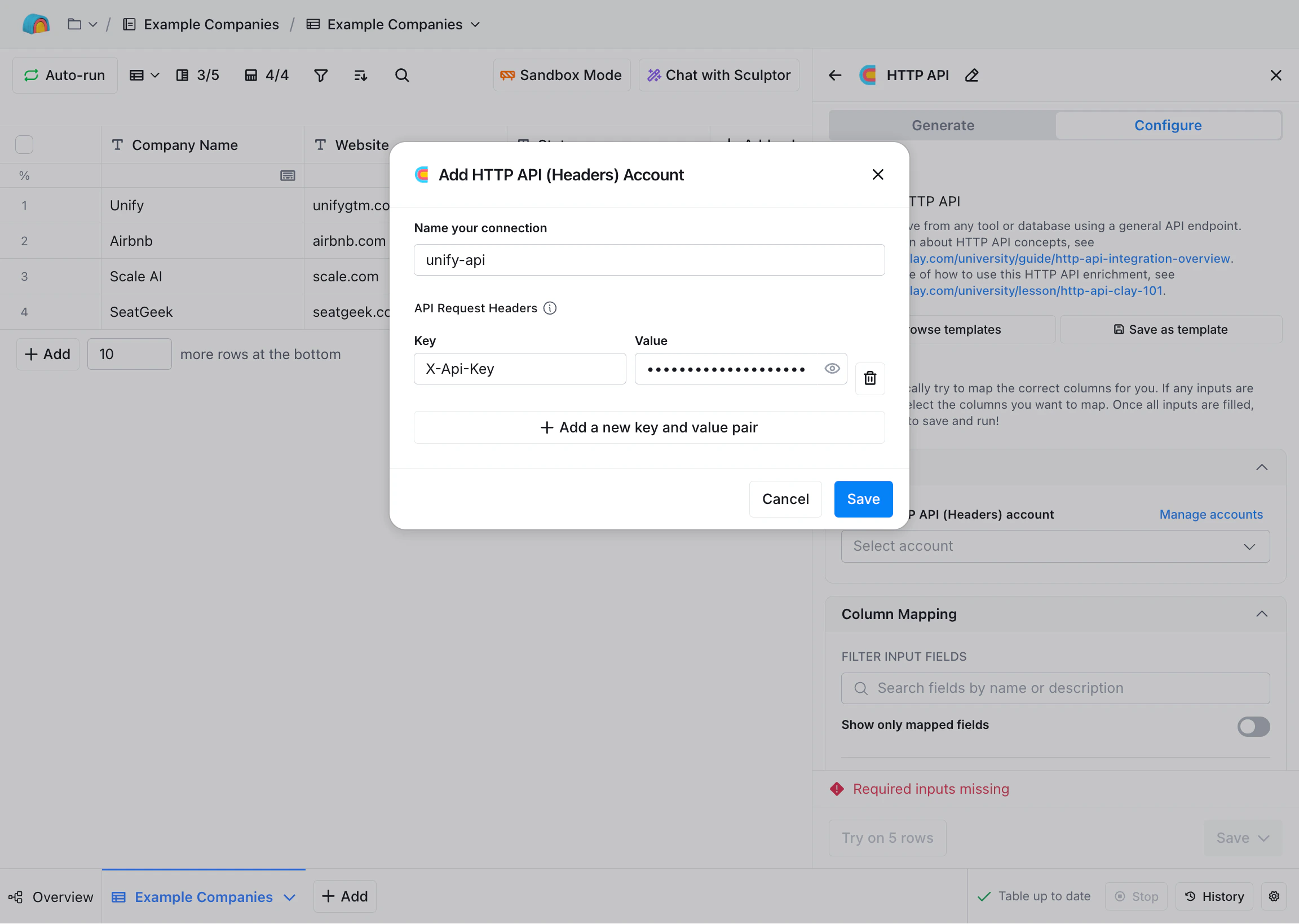 Select **Save** to confirm the credentials.
You can send records into Unify for any standard or custom object using the
[Data API](/developers/api/data/overview). Before constructing the request,
decide which object you want to send records into (e.g., company, person, or
a custom object).
Once you've picked an object, you will need its API name. The API name can
be found on the [object settings page](https://app.unifygtm.com/dashboard/settings/integrations/objects).
For example, the company object's API name is `company`.
For an overview of how objects work in Unify, see [Objects in Unify](/reference/objects/overview).
The best way to send data into Unify is with the [Upsert method](/developers/api/data/records/upsert).
The URL for this API method is:
```http theme={null}
https://api.unifygtm.com/data/v1/objects/{object_name}/records/upsert
```
You will need to replace `{object_name}` with the API name of the object you
want to send records into (e.g., `company`, `person`, or a custom object).
For example, the company object's API name is `company`, so the URL is:
```http theme={null}
https://api.unifygtm.com/data/v1/objects/company/records/upsert
```
Under **Setup Inputs**, fill in a few fields:
* **Method**: Choose `POST` when performing an upsert. For other operations,
use the correct method from the API reference.
* **Endpoint**: Insert the URL of the API constructed above.
* **Body**: A valid payload for the [Upsert method](/developers/api/data/records/upsert). For example:
```json theme={null}
{
"match": {
"domain": "{{Website}}"
},
"create_or_update_if_empty": {
"name": "{{Company Name}}",
"domain": "{{Website}}",
"status": "{{Status}}"
}
}
```
A person upsert can also include a nested company match or upsert:
```json theme={null}
{
"match": {
"email": "{{Email}}"
},
"create_or_update_if_empty": {
"first_name": "{{First Name}}",
"last_name": "{{Last Name}}",
"email": "{{Email}}",
"title": "{{Title}}",
"company": {
"match": {
"domain": "{{Company Domain}}"
},
"create_or_update_if_empty": {
"name": "{{Company Name}}",
"domain": "{{Company Domain}}"
}
}
}
}
```
Be sure to replace these placeholders with the actual column names from
your Clay sheet. Press the slash (`/`) key to select a column when editing
the body.
Don't forget to include quotation marks around the column placeholders!
That's it! All of the other settings can be left in their default state or
modified as needed.
Select **Save** to confirm the credentials.
You can send records into Unify for any standard or custom object using the
[Data API](/developers/api/data/overview). Before constructing the request,
decide which object you want to send records into (e.g., company, person, or
a custom object).
Once you've picked an object, you will need its API name. The API name can
be found on the [object settings page](https://app.unifygtm.com/dashboard/settings/integrations/objects).
For example, the company object's API name is `company`.
For an overview of how objects work in Unify, see [Objects in Unify](/reference/objects/overview).
The best way to send data into Unify is with the [Upsert method](/developers/api/data/records/upsert).
The URL for this API method is:
```http theme={null}
https://api.unifygtm.com/data/v1/objects/{object_name}/records/upsert
```
You will need to replace `{object_name}` with the API name of the object you
want to send records into (e.g., `company`, `person`, or a custom object).
For example, the company object's API name is `company`, so the URL is:
```http theme={null}
https://api.unifygtm.com/data/v1/objects/company/records/upsert
```
Under **Setup Inputs**, fill in a few fields:
* **Method**: Choose `POST` when performing an upsert. For other operations,
use the correct method from the API reference.
* **Endpoint**: Insert the URL of the API constructed above.
* **Body**: A valid payload for the [Upsert method](/developers/api/data/records/upsert). For example:
```json theme={null}
{
"match": {
"domain": "{{Website}}"
},
"create_or_update_if_empty": {
"name": "{{Company Name}}",
"domain": "{{Website}}",
"status": "{{Status}}"
}
}
```
A person upsert can also include a nested company match or upsert:
```json theme={null}
{
"match": {
"email": "{{Email}}"
},
"create_or_update_if_empty": {
"first_name": "{{First Name}}",
"last_name": "{{Last Name}}",
"email": "{{Email}}",
"title": "{{Title}}",
"company": {
"match": {
"domain": "{{Company Domain}}"
},
"create_or_update_if_empty": {
"name": "{{Company Name}}",
"domain": "{{Company Domain}}"
}
}
}
}
```
Be sure to replace these placeholders with the actual column names from
your Clay sheet. Press the slash (`/`) key to select a column when editing
the body.
Don't forget to include quotation marks around the column placeholders!
That's it! All of the other settings can be left in their default state or
modified as needed.
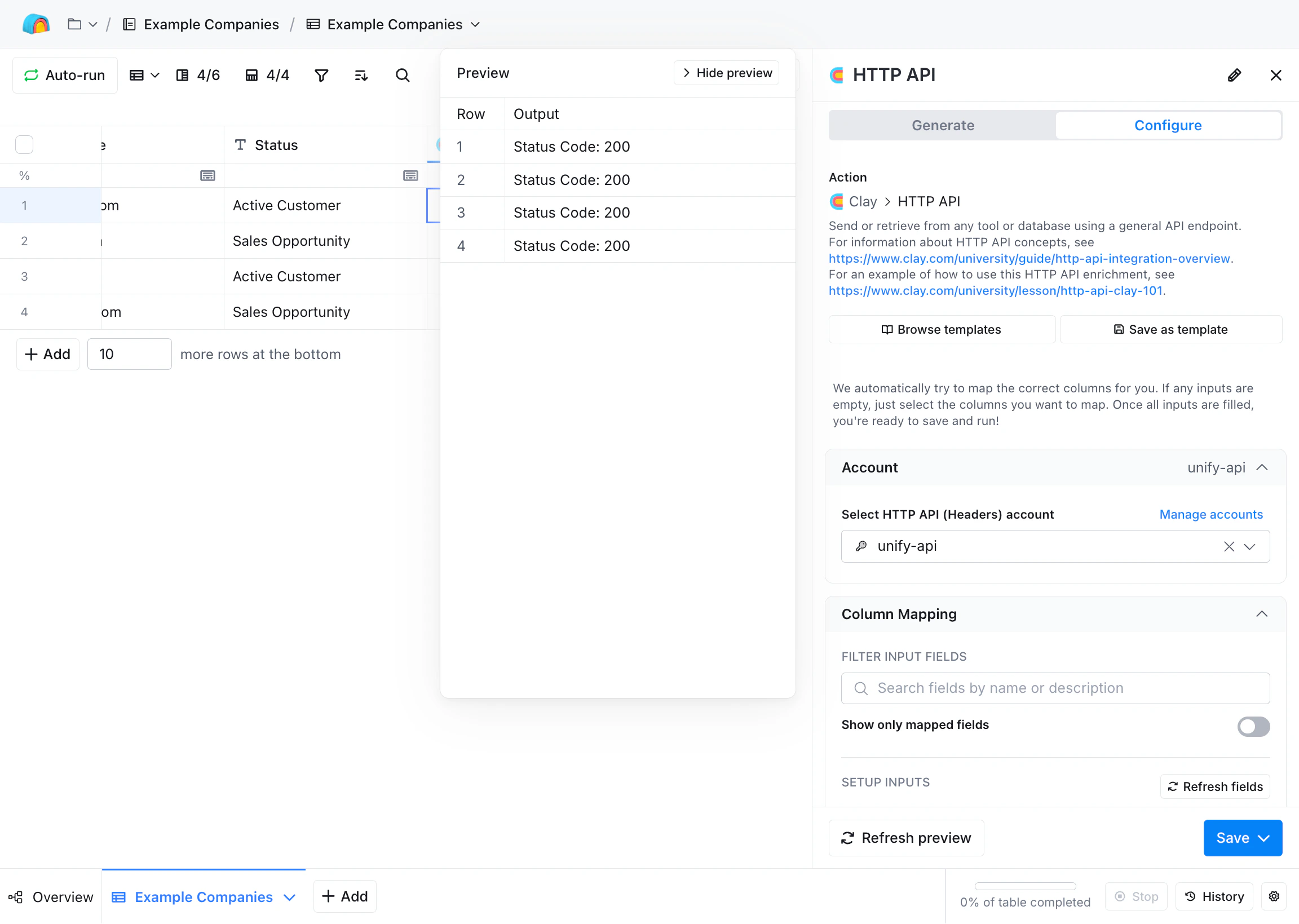
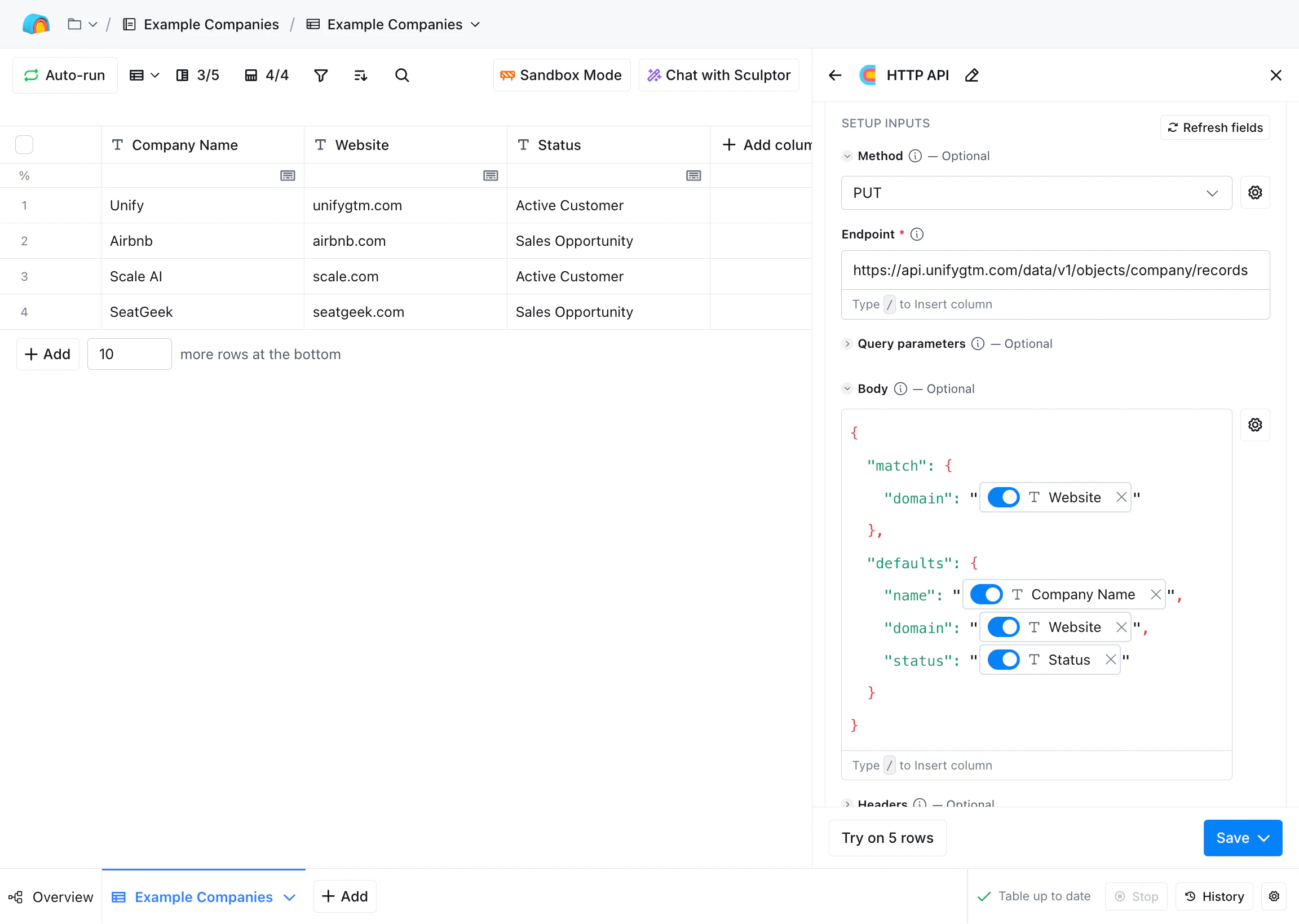 Once the action is configured, you can test it by clicking the **Try on 5 rows**
button. You should see a status code in the range 200-299 if the request was
successful.
Once the action is configured, you can test it by clicking the **Try on 5 rows**
button. You should see a status code in the range 200-299 if the request was
successful.
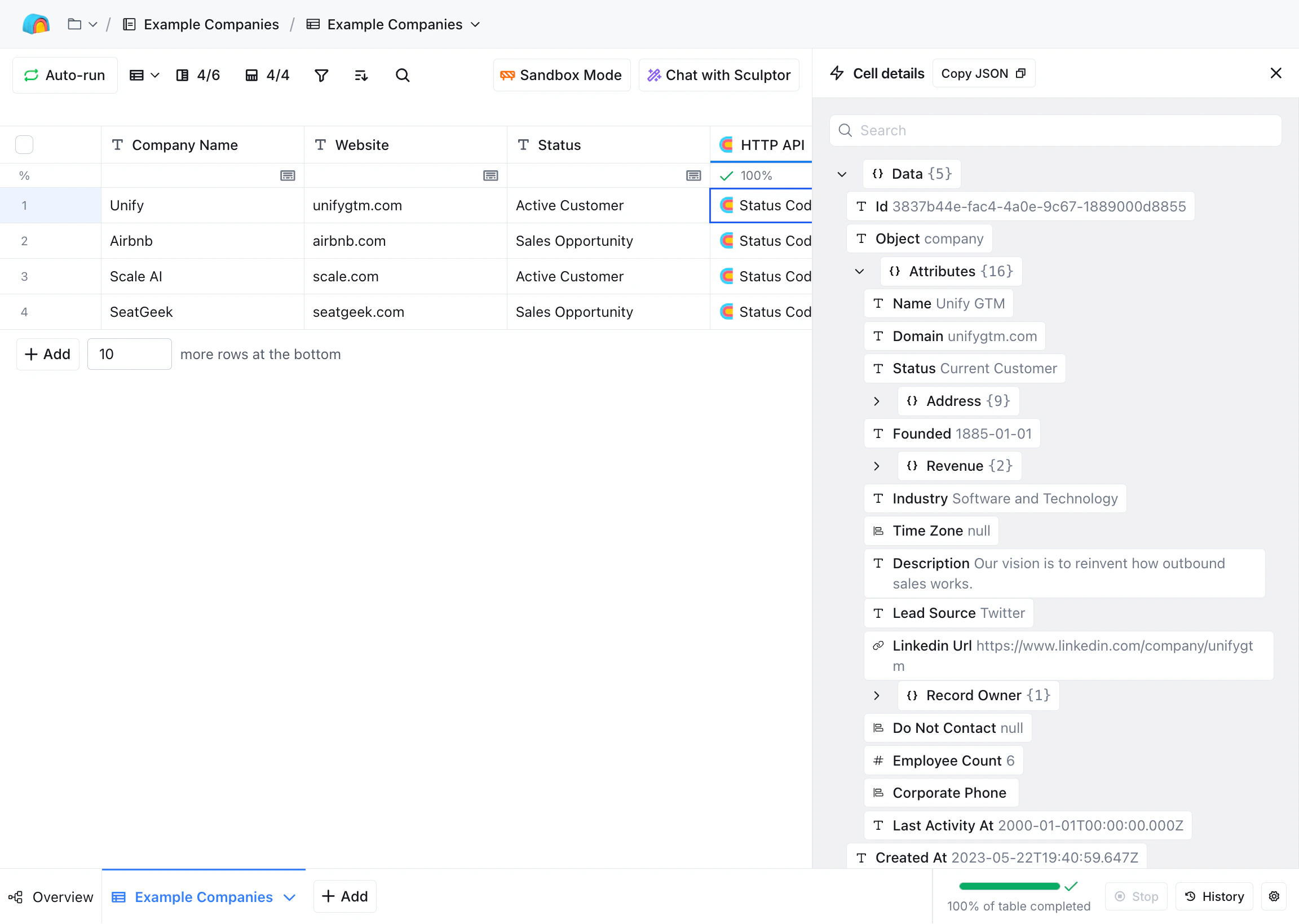
 Finally, select **Save** and choose whether you want to immediately run the
action on all rows in the sheet. Once run, you should see successful status
codes appear in the column.
Finally, select **Save** and choose whether you want to immediately run the
action on all rows in the sheet. Once run, you should see successful status
codes appear in the column.
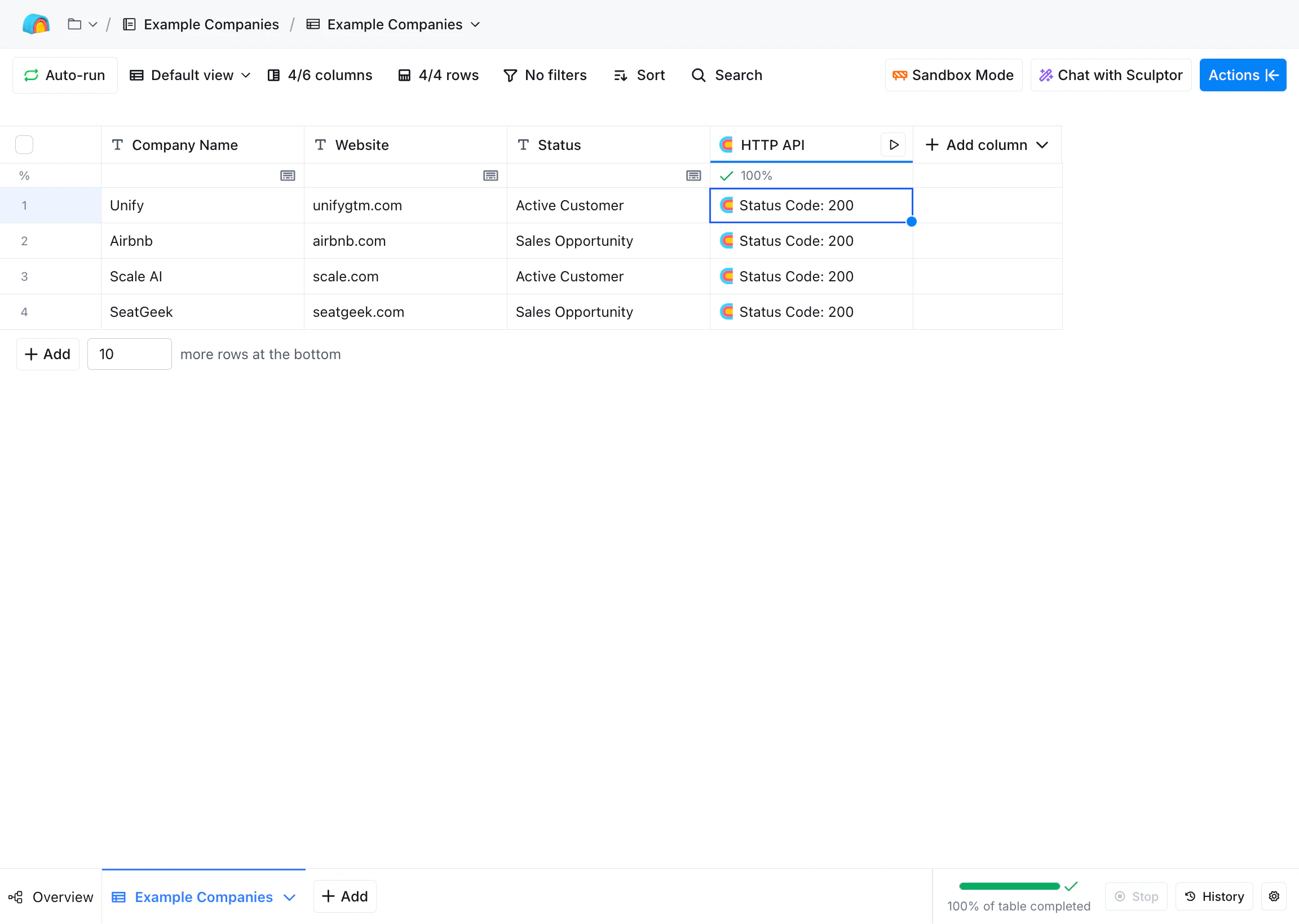 You can click into any cell in the column to see the full response from the
API. Typically, the Data API will return the full record that was created or
updated.
You can click into any cell in the column to see the full response from the
API. Typically, the Data API will return the full record that was created or
updated.
 If you search for that record in Unify, you should see it appear with the
correct data!
## FAQ
Here are a few things to try:
* **Inspect the response**: All error responses should contain details about
why the request failed. Click into the cell in the sheet to view the full
response and look for any error messages or details.
* **Check the object API name**: The URL must use the object's API name,
such as `company`, `person`, or the custom object API name from settings.
* **Check the upsert body**: Upsert requests must include `match` and one of
`create`, `create_or_update`, or `create_or_update_if_empty`.
* **Check the body formatting**: Ensure that the JSON body correctly matches
the expected format of the [Data API](/developers/api/data/overview)
method you are trying to use. Double check that all Clay column variable
placeholders are inside quotation marks.
* **Check nested references**: If you are linking a person to a company,
make sure the nested company value is a valid match, create, or upsert
payload.
* **Check for sheet errors**: Look for a red error symbol in the column name
of the HTTP API column in the sheet. Sometimes, this will indicate an
error in the Clay UI. For example, you may be referencing a deleted column
name, or there may have been a subtle error when pasting the body into the
Clay UI.
If you search for that record in Unify, you should see it appear with the
correct data!
## FAQ
Here are a few things to try:
* **Inspect the response**: All error responses should contain details about
why the request failed. Click into the cell in the sheet to view the full
response and look for any error messages or details.
* **Check the object API name**: The URL must use the object's API name,
such as `company`, `person`, or the custom object API name from settings.
* **Check the upsert body**: Upsert requests must include `match` and one of
`create`, `create_or_update`, or `create_or_update_if_empty`.
* **Check the body formatting**: Ensure that the JSON body correctly matches
the expected format of the [Data API](/developers/api/data/overview)
method you are trying to use. Double check that all Clay column variable
placeholders are inside quotation marks.
* **Check nested references**: If you are linking a person to a company,
make sure the nested company value is a valid match, create, or upsert
payload.
* **Check for sheet errors**: Look for a red error symbol in the column name
of the HTTP API column in the sheet. Sometimes, this will indicate an
error in the Clay UI. For example, you may be referencing a deleted column
name, or there may have been a subtle error when pasting the body into the
Clay UI.